
Process And Assessment

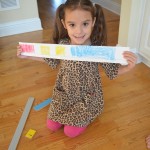
As you would expect, I absolutely love composing with children! The final result is always fantastic, but it is the process that is so fascinating to me. The composition to the right was done by first graders. They chose partners and created a 4/4 measure. We then took their 1 measure composition and decided on the order. Throughout the process children were encouraged to listen, ask questions and then decide on the final order. When I do this with kids, I always ask “What measure should we end with?”. Once that measure is chosen, I ask “What measure should we start with?”. The ending and the beginning always seem to be the easiest and will set the tone for the entire piece. Then when we tackle the middle, it is easier to see what will work. While we figured out the middle, questions and observations came up that indicated how thoughtfully kids were thinking about the final piece. True, some kids want to switch measures around just to be able to participate, but some kids are really listening and rearranging measures to their liking. It is quite cool!!

If you look at the composition, you will notice that no measure ends with a blue and starts with a blue. This was done intentionally. Students didn’t like the way that sounded. They also made a conscious effort to use those measures with the blues to break up the measures with reds, yellows and terra cottas, otherwise, they thought, it sounded too much alike and thus boring. When we tried several versions without the breaks, I couldn’t agree more. However, I make sure to keep my thoughts to myself, as this is their composition, not mine. In the end, they were very pleased with their work, as was I!!

Today’s rehearsal was all about practicing it. We did play it several times through, but that can get monotonous, so I came up with a way to make it a little more fun AND assess at the same time! I told them to listen to what I played through body percussion and to hold up the number of fingers that corresponded to the measure they thought it was. So if I played measure 5, hold up five fingers. I also made a point to mention that your neighbors may be incorrect, so the best thing is to do is to answer for yourself…of course thinking about it now, the better thing would have been for kids to first listen while looking at the measures and decide in their minds and THEN closed their eyes and hold up their fingers. Live and learn!

It was a very fun lesson and kids were able to check their work, as well. A win, win!


5 Ways To Create Good Behavior

When I scroll through the Music Teachers groups on Facebook, there are always posts about how badly students are behaving in their classes. I have certainly seen it, as well ~ we are definitely in the “Entitlement Age”! We have lost a basic respect for each other, as highlighted in how our leaders speak to and about one another. I don’t know exactly why this is, but I do know that it isn’t getting better.

We are limited in the music classroom simply because we see our students so little. We have a lot to accomplish and little time for bonding. We do find ways to connect with our students, but it can be difficult, especially when the issues are on a clinical level.

So what are we to do?

I suggest setting up a “cadre” ~ a framework where there are firm limits for children, but tremendous freedom within those limits. As you might have suspected, I read this in Bringing Up Bebe by Pamela Druckerman. She goes into how to make this work in your home, but here are 5 ideas to make it work in your classroom:

  1. Make sure to cover every procedure and expectation at the beginning of the year and throughout, as new activities are created.
  2. See yourself as THE person in charge. As Fred Jones states in Tools For Teaching “Say what you mean and mean what you say”.
  3. Keep in mind that your students will learn because of you and in spite of you…this is very comforting for me!
  4. As my sister in law says “appreciate your kids”! You may not like everything they say or do, but you appreciate them for who they are.
  5. Allow for small indiscretions ~ kids can’t be perfect every single minute of the day. ….neither can we, for that matter!!

The “Who’s In Charge, Anyway?” Game

There are those days when you just want to deviate from your lesson plan or something unexpected happens and you are required to change it! Here is a lesson to keep in your back pocket for a rainy day and to pull out when you need it!

Materials:

      • 1 Rhythm Stick
      • 2 Sets of Note Knacks or Rhythm Cards

Methods:

    • Have children get into a circle sitting crossed-legged
    • Have children pass around a stick to a steady beat around in the circle (1st student holds the stick vertically and hits the floor with it in front of the 2nd student who is to his right. The second student then takes the sick (still vertically) and hits the floor in front of the 3rd student. The 3rd student then takes it and hits it in front of the 4th student, also to his right, and so on)
    • There are 3 chosen Students Leaders. Student Leader A stands behind a desk with a set of Note Knacks near the circle. Student Leader B also stands behind a desk with a set of Note Knacks, but is at the opposite side of the circle (This is so that everyone can see a rhythm). Student Leader C can stand somewhere outside of the circle.
    • Student Leader A and Student Leader B choose rhythms (that are different from each other) and show them in Note Knacks or using note cards with notation on them so the the kids can see them. You must choose on a time signature beforehand. With Note Knacks, you have the option of having children fit the note values into 2/4, 3/4, or 4/4 Time Signature Frames, which you can switch even during the game! This helps students stay in the limit of the given time signature.
    • Student Leader C yells “STOP” whenever he likes and whomever is holding the stick needs to tap out either of the shown rhythms.
    • It is Student Leader C’s job to figure out, not only which rhythm it is, but whether it is correct or not. If it is correct, that student gets to be Student Leader C. Student Leaders A and B can choose their successors, as well.
    • And the game goes on until everyone has had a turn being each of the Students Leaders.

Why We Need To Slow Down!

2196561648_dfdccd5f72_b

Today I was teaching a violin lesson and we were working on a George Bornoff exercise where one plays the open string 4 times, then the same string with the first finger 4 times, then 4 times with the second and so on until the 4th finger is added. Then one lifts fingers one at a time played in the same fashion. It isn’t all that much fun, but it works!

Like most kids, I HATED exercises like this when I was young. They were boring. I wanted to play Bach and Vivaldi and be able to show off my skills!!! That’s where the glory was, after all!! …of course I failed to embrace the concept that it was those very exercises that made the “showing off” possible!!

I bring this up because there has been a shift in how I think about these warm ups. I no longer loathe them, rather I look forward to them. They require me to slow down. In this fast paced world where we are all trying to stay ahead of the game, I have an opportunity to “connect” with my instrument. I get that this sounds corny, but it’s true. I focus on my posture, how I hold my bow and violin, my tone etc… It is like nothing else exists in the world for that time.

How many of our students experience this? We are always hurrying them along with a sense of urgency, for we know that we only have them for a VERY short period of time and yet ALL of the standards MUST be taught in that time. When do we give them a chance to slow down and be completely absorbed in their learning? For that matter, when do we get to slow down ourselves and truly get absorbed in our teaching? Sure, we get moments here and there, but that clock is always ticking in the background. Thirty to forty five minutes a week (if you are lucky) simply isn’t enough time!!

We must slow down, even when we are in front of them teaching. We must let them get completely involved in their music education, even if we don’t have the time we need. I say this mostly because I need to be reminded every once in a while! I am always ten steps ahead and forget to live in the present. Playing violin helps, but it isn’t always enough. We have the privilege of shaping these young minds in how they will think about music and the world around them. How cool is that??

Do We Teach Music Literacy Too Soon?

This past week I was in TX for their annual music educators conference (If you haven’t been, you should seriously consider going ~ it is AMAZING!!) and I got into a long discussion about music literacy with a colleague. The question became ~ should music literacy be taught in K-2 when we have so little time with them? A valid question and one that has no easy answer. (Of course the real answer is that we need more time with our students and the world would be a much better place if we did see them every day for an hour, but it does not seem like that will be happening any time soon, so onward and upward!)

What is music literacy? Why do we have it at all? Well, without it, we would have lost the most beautiful works by the great composers…and the execution of a symphony would be rather challenging!! In the end, though, it is a recording of one’s thoughts and ideas expressed through something more powerful than words. Shouldn’t young children have a chance to do this? Instead of always being within the teacher’s ideas, shouldn’t we allow them to have a chance to share their own ideas, as well? I would imagine most, if not all, are in agreement thus far. So why have them write music down at all? Simple: there is power in independence. Children are empowered when they are encouraged to record what they think about what they are learning.

We do allow for improvisation, but within OUR parameters! What if we allow them to create on their own, for their own purpose, what then? I think Carl Orff said it best when he said, “I encouraged the activation of the students by the playing of their own music, that is, through improvisation and composing it themselves. I therefore did not want to train them on highly developed art instruments, but rather on instruments that were preferably rhythmic, comparatively easy to learn, primitive and unsophisticated.” To me this says it all. (You can read more on this in a birthday post I had written awhile back…) If we give them the tools, they can do great things on their own. I’ve said it before and I will say it again, we underestimate children ALL of the time. Who are we to determine what their capacity is? It is our job to be their facilitators, not their gurus!

I encourage you to weigh in on this debate. I want to hear your thoughts as there are many philosophies out there.

We Build Better Brains!!

1415626490540-5iww2lynuhk2-45f25a974853866472bc9318bd31ae4f

Parents do not always recognize what we do or realize the impact it has on their child’s learning, so I crafted this article for our parents to let them in on what all of us know ~ we build better brains!

I share this with you not only as a bit of inspiration…after all, I do call these newsletters “A Little Midweek Inspiration”, but as a template to perhaps encourage you to write to your own parents to let them know how truly valuable you are to their child’s present education, as well as for future learning! It is short and to the point, making it quick and easy to both write AND read! Enjoy!!

Dear Parents, 

Your children are AMAZING!! We are exploring how to read new rhythms by using the steady beat as our guide. Students are learning to keep a steady beat in their head while they tap out a given rhythm. It has certainly gotten silly at times, as doing these 2 things at once can prove to be quite challenging, but we are getting it! The best part about it, though, it that we are learning a strategy to tackle unfamiliar music. As we go through these exercises, we are closer to being able to read a piece of music, which according to many studies is helping us build a better brain!

Harvard neuroscientists in Boston, MA have determined that there are four ways to actually build a better brain throughout your life through “neuroplasticity” the growth of the connectors between left and right hemispheres of the brain. (It has been said that what helped Einstein, a violin player, be a genius was that his left and right hemispheres were so well connected:  https://www.psychologytoday.com/blog/the-athletes-way/201503/10-ways-musical-training-boosts-brain-power )

 The four activities determined to have the most important effect are

  • Making music
  • Movement
  • Creative Play (returning to childlike attitude of play, imagination)
  • Numinous Experience (those experiences in which our sense of self is absorbed into something bigger than we are)

(Taken from one of Mary Knysh’s handouts)

 Of course, these are all activities that we are doing here in choir!

 I hope this was helpful! Have a great rest of your week and please, as always, let me know if you need anything! Again, here is the link to easily get in touch with me: https://noteknacks.com/contact-us/

Rhythm And The Steady Beat Part 2

Last week I spoke about teaching the kids how to learn new rhythms through the steady beat ~ click HERE to read. This week I want to talk a little about beats and length. We don’t really teach this. On a whole, we don’t single out notes and have kids explore counting the beat to them. It is considered too cerebral and not musical enough….and believe me, I have certainly run into this! Today, in fact, being the case in point, but that is for another day!

So I took out a half note and asked the kids how many quarters would fit into it? (I did this with second graders on up.) Two, they answered. “OK, so if I am saying a red steady beat… red, red, red red, red, red, etc…, how many reds would I count while I hold the blue?” “Two”, they answered once again. “Right!”, I said! So we did it; I counted the reds on my fingers while they said the blue. We practiced this for awhile. I then did this with the yellows and the terra cottas. (I then went on to have them figure out counting the grey.)As expected, the kids needed some help in counting while holding a note, but I treated it like a game. I even challenged them to see who could count in their heads and sing the note by themselves. Some kids could and some had a hard time, but we ended up having a big laugh over it. I tell them when I am pushing them. I will say that “This may be a bit too hard, but I always like to see what you can do”. I also am clear that if they can’t do it, nobody cares. It’s for fun! This works well, as it gives them an opportunity to see what they are capable of without any pressure to get it perfect.

Having kids start to count various notes in their head while they sing a length of sound is an important exercise. It emphasizes the relationship between each of the notes and solidifies the concept of the steady beat versus the rhythm.

If you have read my blogs long enough, it is easy to tell that I seldom believe what the standard says kids should learn at what time. Yes, sometimes, the general thinking is correct, but often times we underestimate our students. We are so set in what “the research” says (..and that can be disagreed upon!) that we forget to check in with our kids and see what they can do. More often than not, they will blow us away!!

So I check in. I push them and see what happens. Sometimes they exceed my expectations and do beautifully ….and sometimes I blow it and they look at me like I am nuts, but in the end, they know that I think they are smart and capable students! This, above all else, is the message I want them to remember as they go through school!!

Rhythm And The Steady Beat

b

I am so excited about a lesson I did with my students last week! In a piece of music that we are working on, there is a particularly difficult rhythm. It is a sixteenth syncopated rhythm, of course, and I was thinking about how to teach it like a professional musician would break it down and learn it. I also wanted my students to get a visual on how the steady beat is the key to reading any given rhythm at any time.

In the end, I want my students to have strategies. Strategies for how to figure out new rhythms beyond using colors or syllables. I also want my students to understand why a certain strategy works and how to use it.

So here it is:

Objective

Students will understand and learn how to use the steady beat to read rhythms

Methods

  1. Create a rhythm using your 4/4 Note Knacks Time Signature Frame and blocks. For example: eighth, eighth, quarter, quarter, quarter
  2. Have kids tap rhythm out
  3. Ask students what the shortest note is (eighth)
  4. Place 8 eighths in front of frame (It helps to have another set of Note Knacks for this!)
  5. Tap the eighth steady beats as kids tap rhythm
  6. Slow it down and do it again, but this time tap the eighth blocks as they tap the rhythm
  7. Ask students which eighths did you tap on? (1st, 2nd, third, 5th and 7th)
  8. Push those eighths forward that they tapped on
  9. Do this process again with many rhythms
  10. With older kids you can try out a syncopated rhythms ~ I was so amazed at how easily they got it!! Have them decide which eighths they tap on and push those blocks forward before they attempt the rhythm. It will make all the difference!

Discuss

                  Find out what the kids thought:

  • Why do you think we used eighths instead of quarters or sixteenths? (let’s try it)
  • How does the steady beat help us figure out the rhythm?

When we moved to syncopated rhythms, they got it because they figured out the formula ~ they understood which blocks to tap on and which to stay silent on. This is huge! We primarily dealt with quarters and eighths, so sustaining didn’t come up with 2 groups, but it did with one group. This is when I realized I needed my students to explore the concept of sustaining sound for a certain number of beats. I will cover this in next week’s newsletter…so stay tuned!!


How To Get The Most Out Of Your Small Groups! 2.0

1481670537593-v4rrsd9kgqyv-25d12761f1cb4d002a1a9c535aa14d20I love putting my students into small groups! It benefits them in so many ways and it allows me to step back and observe ~ something that we do not get to do very often! It also allows me to connect with students individually as I ask questions about their work or offer assistance when needed. I know it isn’t done that often in elementary music, as you can’t ask second graders to go off and work on measures 3 – 8 in a song that we are in the process of learning, but when it is done, the advantages become obvious ~ here are the big 3:

  • Kids get a chance to work with the materials without the teacher or ALL of the other kids looking at them. This allows for more exploration and observation.
  • Kids can chat with their classmates about what they are working on and/ or SOME regular chit chat. I do allow some conversations beyond what they are working on, as it fosters a happy working environment and builds community.
  • Kids can get more individual attention as I am walking around.

So how do you get the most out of small groups?

  1. Start with a lesson where kids can work independently on those concepts that were covered. The Note Knacks Music Lesson Plans are filled with these!
  2. Once the concept has been covered, tell the students that they will be getting into small groups to practice what they have just learned.
  3. Tell them the task they will be accomplishing and the steps they need to go through to do so. (You can write it all on the board for reference)
  4. Assign groups and have a bit of a discussion on what this will look like:
    • How will kids get the materials they need for the activity?
    • Where will they work?
    • How do we share the materials so that everyone gets a chance to use them?
    • What sort of chatter do you think I expect?
    • Is there a leader? Should there be? How do we work together?
    • How should we clean up?
    • Where do kids return the materials after they are finished with them?
  5. Have a group of kids model what that will look like
  6. Send kids off to “practice” for this small group activity
  7. You can also have a discussion at the end where you ask the kids how it went. If there were conflicts, how did you solve them? Were there any issues that came up that are not resolved? Does the class have any ideas on how to solve those? Are there things we can add or take away from our process that would help the overall experience?

I have found that the school culture and especially the regular classroom culture play a large role in how well this goes! If kids are used to working in small groups and their teacher is good, you will have no problem; however, if the opposite is true, the discussion with the kids will help a great deal! It may take a little longer, but they will realize what you expect and do what they need to in no time!

Keep Your Audience Engaged!

people-enjoying-rock-concert-with-heartshape-hand-gesture

Photo credit: Foter.com / CC0

Good Morning!! We are in the home stretch ~ Wahoo!! Only a few more days…. we can do it!!

As concert dates are quickly approaching, I know how stressful things can get! So in this issue, I thought I would give you some ideas on how to involve the audience both before, during and after the concert. It isn’t only to create a fun environment that parents will enjoy, but it will also help to cut down on disruptions. Sometimes parents and guests aren’t always clear on how to act at a children’s concert, so if you keep them busy and/ or give them some guidelines that their children have written (for a class exercise, of course!) they are more likely to do what we need them to do! (sneaky, I know :-))

BEFORE:

  • Have students ask their parents about the school concerts that they remember from their childhood. What songs did they sing? Did they have a favorite? Did they play an instrument or participate in a dance?
  • Post some rehearsals on your website and put the link on the program so parents can see how far they have come! (ok, I should have probably mentioned this in early November…I apologize!)
  • Kids come up with an audience behavior guide for concert program (posted as ~ NOTE: we have been learning about the proper way to sit through a concert and this is what we decided upon!)

DURING:

  • A type of sing-a-long:
    • Partner songs: Maria Witthoft Hare suggested ~ Rudolf and Frosty work together and Phyllis Horridge suggested Holly Jolly Christmas and Rudolf. I thank them both for their suggestions!!
    • A holiday round
  • Give audience movements to do through a familiar song or during the chorus of another
  • Hand out instruments, such as Boomwhackers, hand drums, etc… for parents to keep a steady beat or to play a simple rhythm throughout the chorus
  • Choose a couple of students to teach a mini lesson to parents that illustrates what they have been learning in your class (this is great for music advocacy, as well!)

AFTER:

  • Give students a mini questionnaire to give to parents to see favorite songs, numbers, etc… throughout the concert
  • Choose a student to write an article and have them interview attendees afterwards to hear others’ opinions