
10 Morning Messages That Make the First 5 Minutes of Music Class Count!
When I was in graduate school, I did my student teaching in a first- and second-grade looped class. This meant that students would have the same teacher for both first and second grades. Although this teaching model has both positives and negatives, I learned a great deal about how to accommodate multiple learning levels. I also learned simple strategies and ideas to help students learn in fun ways.
In the ’90s, the “morning message” was all the rage in Massachusetts’ elementary classrooms. Ruth Sidney Charney’s book Teaching Children to Care: Management in the Responsive Classroom had just come out, and this new approach to building communities in our classrooms was very popular. My student-teaching classroom was no exception. Every morning, the kids would walk in, read the message, and complete the posted activity. It was an easy way to give students information and directions without having to wait for everyone to arrive. It also allowed us (the classroom teacher and me) to assess their ability to read, follow directions, and complete the work. It was a quick, easy way to assess student learning with little effort. Woohoo!
When I moved to the music classroom, I was always looking for ways to assess my students quickly and easily. We have so little time with our students that we need to optimize every single minute of every class. Morning messages help a great deal with this! Every class comes in as a group, as opposed to trickling in whenever, but there can still be a settling-down period. A morning message gets kids working immediately without the added step of giving directions. It also allowed me to do a quick roll call and take care of any last-minute prep for the class. Sometimes, I would see a kindergarten class right before a fifth-grade class, leaving me only a couple of minutes to prepare. Ahhhh, the life of an elementary music teacher!
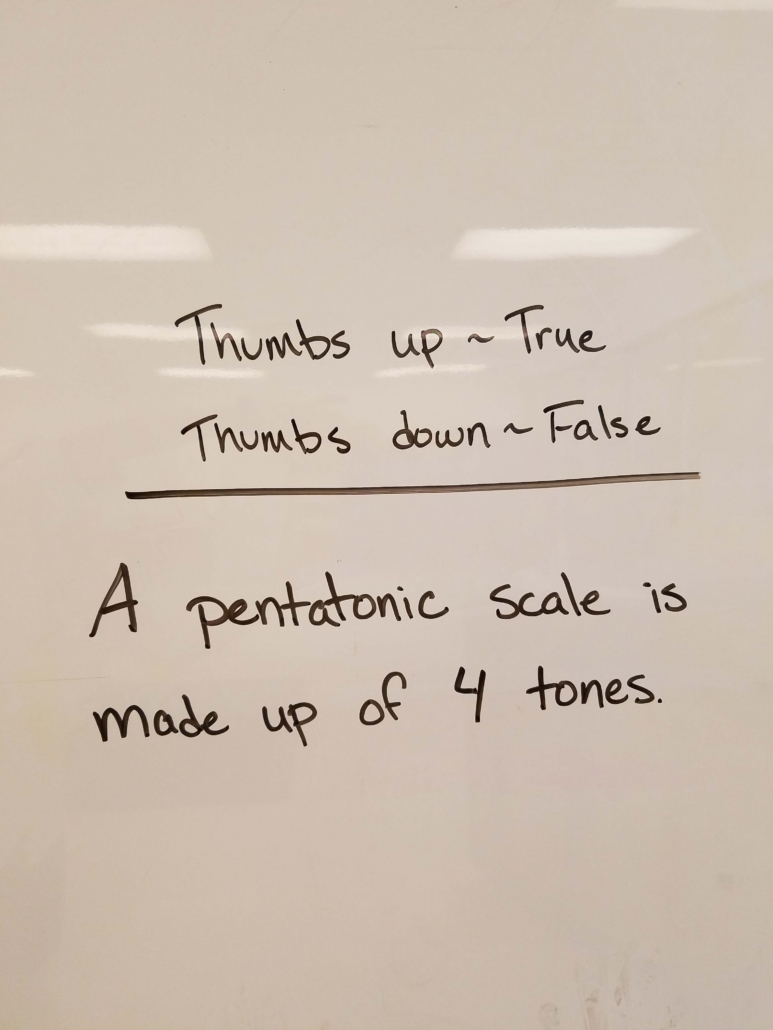
Morning messages are flexible in how they are executed. They can be as simple as “Thumbs up for answer #1 or thumbs down for answer #2,” or they can be more complicated and involve a few steps, such as: “First, grab these materials. Second, find a place to work or go back to your assigned spot. Third, create a four-measure rhythm with two half notes in it. Fourth, choose an instrument to play.” Either way, it is a tool to use as needed. The message could also be different for each class within a grade level. That can create more work, but perhaps one class is having trouble understanding eighth notes versus half notes. You can change the message accordingly. It’s up to you!
This is also a great way to reinforce important information students need to remember, such as concert details. For example, you could write, “Remember to wear a white top and black bottoms for tonight’s concert,” or “Be in the gym by 6:30 p.m. for Friday’s concert.”
Although the “morning message” happens throughout my day, I still call them morning messages. For fun, you can ask your students to come up with a different name and see what they say!
To get you started, here are 10 “morning messages” for your 3rd through 5th grade classes:
- Good morning, musicians!
Grab a piece of paper and a pencil and answer this question: “What are the instruments in the string family?”
- Good morning, musicians!
Grab a piece of paper and list all the rhythms that will fit into a 4/4 measure using only quarter notes, quarter-note rests, two beamed eighth notes, and/or half notes. The person with the most correct rhythms will choose the game for the last five minutes of class. If there is a tie, the next student will lead the game next week.
- Good morning, recorder players!
Take your seat, take out your recorder, and, WITHOUT playing it, practice fingering the notes to “Hot Cross Buns.”
NOTE: When students first get their recorders, have them practice fingering the notes without blowing into the mouthpiece. This allows them to focus on one skill at a time and check whether they are completely covering each hole. It’s also a helpful strategy for students who blow into their recorders without permission. If you have a two- or three-piece recorder, simply remove the top so students can practice fingering along with everyone else. They won’t miss out on the practice, and you won’t have to worry about unwanted sounds!
- Good morning, drummers!
Grab a djembe or tubano and find a seat in the circle. Start improvising softly until I give you the sign to stop.
- Good morning, drummers!
Find a partner and grab a djembe or tubano for each of you. Take a set of Note Knacks, a pencil, and the worksheet with four blank measures. Find a spot in the music room and create a piece in 4/4 time that you can perform for the class using your drums.
- Good afternoon, musicians!
Grab a piece of paper and a pencil. Last week, we learned the names of the line notes on the staff in treble clef. Create a sentence in which the first letter of each word matches the name of a line note. For example: “Every Good Boy Deserves Fudge.” Make sure your first word begins with an E.
- Good afternoon, musicians!
Get into the small groups listed on the board and grab a set of NK Dice. Play the game we played last week.
NOTE: I have included three dice games to try out!
- Good afternoon, musicians!
Grab a piece of paper and a pencil and answer this question: What note is on the second space of the staff in bass clef?
- Good afternoon, musicians!
THINK about how many notes are in a pentatonic scale. When I ask the class, hold up that number of fingers.
- Good afternoon, musicians!
THINK about your answer first. When I ask the class the following question, give me a thumbs-up if you think the statement is true or a thumbs-down if you think it’s false:
“A dynamic marking of FFF means the piece should be played very quietly.”
The best part about morning messages is that they don’t have to take a lot of time to prepare! You don’t need to create something brand new every week. Try using the same format throughout the year and simply change the musical concept you want students to review. Once your students get into the routine, they’ll know exactly what to do, and you’ll have a simple, effective way to reinforce learning while making the most of those first few minutes of class. Give it a try and let us know how it goes! We would love to see the morning messages you create and use with your students. Share them on our Note Knacks Facebook page so we can all get inspired by each other’s ideas!


Leave a Reply
Want to join the discussion?Feel free to contribute!