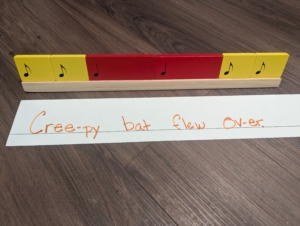
Halloween Compositions Extended

Building on our “Simple Halloween Compositions” activity, there are so many creative possibilities to explore! What starts out as a simple 1-measure composition can grow into a variety of musical experiences. With a little imagination, this single activity becomes the springboard for endless opportunities where students can create, explore, and truly make music their own.

Here are a few ideas that will be fun for kids, but will still reinforce important musical concepts:

  1. Now that each group has a set of 3-5 one measure compositions (from the last lesson), kids in each group can:
    • Put their compositions together in an order they like (try out an order, say it out loud together, rearrange, as needed). Have them perform it in front of the class either chanting the colors or using body percussion.
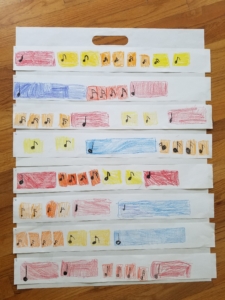
    • Choose instruments that represent their group composition and perform that for the class. For example, if their group composition focuses on ghosts, what instruments could they play to illustrate that? What instruments sound like ghosts?
  1. With each group having a 3-5 mm piece that they can play on instruments, you can make it one longer piece. Have each group play their piece either with a measure of rest in-between each group like THIS or played consecutively.
    • You can also insert a TALA after each group’s compositions and have them improvise on their instruments.
    • If you have a Halloween song that your kids love, use the song as the A Section and their classroom piece as the B Section. They can either chant the scary words or play it on their instruments.
  2. At this point, the text doesn’t create sentences that make sense. It’s just silly and for fun. Now that kids have taken that out for a spin, it’s time to refine it a bit:
    • Kids in the early grades are learning about nouns, verbs, and adjectives. For a great cross-curricular activity, look at your three lists of words as a group (quarter/ 2 eighths / 2 eighths with one quarter) and have kids identify each word as a noun, verb or adjective. Then have kids create a sentence together as a group that fits into a 4/4 frame using at least one noun and one verb. It is a good idea to do this A LOT as a whole group before sending them into small groups. They will need the practice.
    • Here’s an example, use the word bat as the noun, creepy as the adjective and flew as the verb: Creepy bat flew _____. Set it up on a frame:
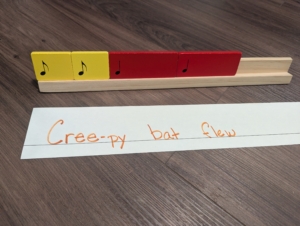
    • There is space left over in the measure. What should we do with it? FIRST, what lengths fit? A quarter? An eighth? 2 eighths? A half? They will have fun figuring it out!
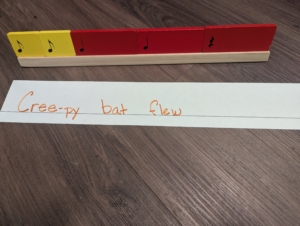
      • A quarter note:
        • Use a rest (a great time to introduce it or reinforce it as how we account for the space. Also there are 2 sides to every Note Knack ~ a sound side and a rest side)? Do we not want a sound?
        • Use a quarter and add a clap, a hit on a drum, etc.. OR add another word that would make sense like “back”?

          • 2 Eighths:
            • What sound would we like? (Again, great time to point out that instead of using 2 eighth rests, we can simply use a quarter rest). 2 claps, 2 hits on a Boomwhacker? Add another word like “over”?

4.  Dynamics are another great way to bring a composition to life! How can changing the volume make their compositions more interesting? Have students use piano (soft) for words like “tiptoeing” or “sneaking,” then switch to forte (loud) for a sudden crash or a big, dramatic “BOO!” It’s a fun way to reinforce dynamics!!

Here are just a few ideas to get you started, but I am sure that as you do this with your kids, they will have wonderful suggestions to enhance their compositions and make them as silly or spooky as possible!! Happy Halloween!!

Steady Beat Explorations ~ Part 1

Last week I went to the GA music educators conference in Athens. I was lucky enough to hear Dr. Boonshaft speak about our profession and how our job was to make kids curious (I encourage you to check out his work. Here is Part 1 and Part 2 of an interview he did on YouTube.) I love that, as this is what we are all about at Note Knacks Music! We love to give kids the tools for them to explore and discover what is possible in music!! 

“Chicka Chicka Boom Boom” ~ How to make composing with little ones simple!

Chicka Chicka Boom Boom is the perfect book to incorporate into a Kindergarten music lesson! Lots of kids know it, it has its own steady beat, and it is a lot of fun!! I have updated it a bit by inserting a TALA (you know how I love my TALAs!!!) and have given an example of what to play. Of course, you can play/ do anything your kids can dream up!!

Objective

  • Students will make the connection between language arts and music
  • Students will create a 1-measure composition to use after each page

MATERIALS

  • Book “Chicka Chicka Boom Boom” by Bill Martin Jr. and John Archambault
  • 5 sets of Note Knacks and Time Signature Frames
  • Classroom instruments of your choice

Methods

  1. Read book and have children tap the steady beat as you read.  “Notice how words can be said to a steady beat”. (This is a great time to highlight poetry)
  2. Read a second time and add a 4 beat TALA after every page turn. There are 15 turns including adding one at the very end of the story. (Kids can tap out 4 beats for the TALA, if you would like.)
  3. Create a 4/4 rhythm with your students using one of the Note Knacks sets and have kids practice it.
  4. Read the story a third time, but instead of a silent 4 beat TALA, have kids tap out the created rhythm each time.
  5. Now send children into 5 small groups to create their own 1 measure composition (you could increase it to 2 measures, if you would like.)
  6. Read book a fourth time and have Group 1 tap out their rhythm after the first page turn, then have Group 2 tap out their composition after the second page turn, and so on. There are more pages than groups, so you can divide it up as you like. Example: Have each group take 3 pages and at the end have everyone tap out their rhythm in a predetermined order.
  7. Have each group choose an instrument and when it is their turn, have them play their composition on their instrument

Assessment

  • Did the students create a rhythm in 4/4 time?
  • Did the students play their rhythm correctly?
  • Did the students play their rhythm at the correct time?

EXTRA POSSIBILITIES

  • I encourage you to also use the book “Jamberry” by Bruce Degen! It is a great book to use in this lesson! Try reading it in 3/4 time and having four 3/4 measures after each page turn.
  • When you put all of the measures together at the end, have students make it into a classroom piece adding tempo, dynamics, and an orchestration.

A Snow Poem with a TALA

Here is a lesson from my “Pushing the Limits” Collection ~ Lesson One 2.0

Although, rests aren’t discussed until Phase 3 of the Note Knacks Curriculum, children will write rests instead of notes when they trace their blocks in Phase 2. This is a perfect opportunity to point out the difference between rests and notes. When it happens, this is a wonderful lesson to teach. 

Objective

  • Students will practice using rests
  • Students will use them in their compositions.

MATERIALS

  • Set of Note Knacks and the 4/4 Time Signature Frame
  • Rhythm instruments and/or Orff instruments
  • Poem: (words on top, rhythm on the bottom)

           We are lit-tle Ic-i-cles             / Melt-ing in the sun

           Yel-low yel-low yel-low red/  Yel-low yel-low red rest


           Can you see our ti-ny tear-drops / fal-ling one by one

           Yel-low yel-low yel-low yel-low   /  Yel-low yel-low red rest

METHODS

  1. Have children talk about what the poem means, drawing attention to what happens to water in different temperatures & what teardrops signify.
  2. Discuss Rests: For every length of sound there is an equal length of silence. Show the red Note Knack block to point out that one side has a note on it and the other has a rest on it.
  3. Using the 4/4 Time Signature Frame, work out each line of the poem, leaving the rest beat blank in the Frame and asking the students to fill the missing piece. Highlight that all four notes in the measure need to be accounted for with either notes and/or rests.
    1. As they figure out the rhythm for each measure, write it on the board in conventional notation.
  4. Have the students choose instruments to play the whole rhythm.
    1. Play it a few times through
  5. For this class or the next ~ Use the poem as an A Section and create a TALA of 8 beats for a B Section.
  6. Demonstrate how to improvise an 8-bar rhythm utilizing rests.
  7. Have students take turns improvising rhythms for 8 bars utilizing rests. (It can be as simple as a steady beat with one rest included)
  8. Using Note Knacks and the 4/4 Time Signature Frame, divide students into groups and have them create a 2-4 bar rhythm that incorporates a rest. Be sure that each measure stays within the 4/4 Time Signature Frame.
    1. NOTE: I have made the mistake of having each group create 1 measure that includes a rest. When you put all of the measures together, there are too many rests. Since then, I have had kids create more measures, still with only one rest, so that the new concept doesn’t show up in every single measure, possibly one right after another. It is usually too challenging.
  9. Put all of the compositions on the magnetic board or in a pocket chart and have kids decide on the composition order for a B Section. (Play it through many times moving measures around until the kids hear one, they like. Ask the kids which measure to move where. You would be surprised at how thoughtful they can be in their answers!)
  10. Have class play A Section (the poem rhythm) then the B Section ~ and A again, if you would like!

Assessment

  • Did the student understand the difference between a note and a rest?
  • Did the student create a 4/4 pattern using a rest?
  • Did the student play everything correctly?

Extra Possibilities 

  • This is a good way to incorporate Language Arts standards into the music room.
  • This can be used with other poems
  • Teach it in one class or over multiple classes

“The Mitten” Composition

…..another concert possibility…..


Last year, my first graders added sound to “The Napping House” by Audrey Wood. Each child or group of children were assigned a character and played their chosen instrument when that character’s name was mentioned. It was a lot of fun and was a fantastic last-minute addition to a spring concert!

I decided to adapt this idea to a winter theme and used the book “The Mitten” by Jan Brett. This is a wonderful story of a lost mitten that provides a cozy place to relax for some woodland animals. As each animal finds a spot within the mitten…… or as they push their way in a bit…. the mitten grows larger and larger until a little mouse (like the flee in The Napping House”) creates chaos and they all exit!

Creating music to accompany this book is a simple way to bring the story to life! Each animal gets its own 2 measure composition and is played after each is introduced. For a next step, your class can put all of the 2 measure compositions together and create a stand-alone piece ~ making decisions about the order, tempo and/ or dynamics! What a blast!!   

The Mitten by Jan Brett

  • This is a modified Ukrainian folk tale
    • What is a folk tale? 
  • While the boy has his journey, the mitten is experiencing its own adventure accommodating more and more animals
  • Just like folk tales, there are folk songs 
    • Sing examples of folk songs you are singing in class
  • What does Ukrainian folk music sound like? (Popular Ukrainian Folk Songs | Smithsonian Folkways Recordings (si.edu)) What does Ukrainian folk dancing look like? ( HOPAK: Traditional Ukrainian Folk Dance – YouTube )
  • Let’s add our own take to this story by giving the animals sounds
  • Process ~
    • Paying attention to what the author writes, what do you think each animal sounds like? (Use your voice first)
      • Do you think the animals’ actions are a series of short sounds or long sounds? …or are they using one long sound? (For example: scurrying = lots of short sounds, hopping = eighths, owl swooping = half note)
    • Assign an instrument to each animal
    • There are 8 animals total, so you can do the first 3 animals as a group, then divide the class into 5 small groups.
      • Each group gets 1-2 sentence strips depending on how many measures you assigned, a set of Note Knacks and crayons
    • The Task: Create a 1 – 2 mm composition to illustrate a particular animal / what would that animal sound like? (Build on what was discussed)
      • Click HERE for a detailed lesson plan on how to do this
      • Can use a 4/4 frame or have it played without meter
    • Play composition after each animal is mentioned
    • Put compositions together to create a stand-alone piece (have kids decide order, dynamics, tempo, etc.…) If there isn’t a meter, put 4 beats of rest in-between. 

We would love to hear how this lesson worked for you in the comments below! 


The “Short on Time” Solution For Your Winter Concert

As I am planning our Winter concert, I am realizing how little time I really have ~ how little time we all have. We need to cover standards, while providing a range of repertoire, while working on the present holiday music (Halloween etc.…), while making it fun…. No problem!! LOL!

Solution: Build on what you have done with your kids thus far and build it into the concert!

How?

EXAMPLE 1:

For the last few weeks, the 6th graders have been composing short rhythmic pieces. We could have combined them to create a longer piece to stand alone, but instead I wanted to play them with a Music K-8 recorder piece “Santa’s Back in Town” (Volume 32 No. 2) because it is so festive!!

PROCEDURE:

  • Get out your Note Knacks! (Manipulatives are always good to have as a reference, even for the older kids!)
  • Divide students into groups
  • Have them compose a short rhythmic piece. The number of measures will depend on the instrumental music you have chosen.
    • If there are 30 measures and you have 25 kids, divide class into 5 groups and have them compose 6 measures each.
  • Give each group a set of instruments including pitched and non-pitched percussion. (NOTE: To make it easier, have kids only use the notes in the pentatonic scale of the key that the instrumental piece is in)
  • Each group’s TASK ~ add orchestration to your rhythmic piece.
  • When done, combine all of the pieces and together decide on the order.
  • Play with instrumental piece.
  • Edit as needed!

EXAMPLE 2:

In 1st grade, kids created a Halloween piece by brainstorming spooky words, sorting them into 1 or 2 syllables, and matching either a quarter note or 2 eighths to each word, then putting them together to create a composition. The kids LOVED it!!!

We can use this same technique for a Winter themed piece:

  • As a stand-alone rhythmic composition
  • To be played with an instrumental piece
  • To replace a sung verse

PROCEDURE:

  • Use same procedure for Halloween Compositions, but brainstorm winter themed words instead ~ Simple Halloween Compositions – Note Knacks
  • Have kids create 2 measures each instead of one.
  • When done, combine all of the pieces and together decide on the order.
  • Practice and edit as needed!

Time is and always will be an issue, but we can “teach smarter”! It makes so much sense to build on what we are already doing, as it will create continuity for the kids and nothing is sacrificed for the concert!! Of course, any time the students are involved in the planning, they will be more invested, and their enthusiasm will show through!! What could be better than that?  


Simple Halloween Compositions

Halloween is just around the corner—crazy, right?! 🎃

Here’s a fun Halloween activity to try with your first and/or second graders that is sure to bring out the ghosts and ghouls! It doesn’t take a lot of prep time, and the kids will get super excited about creating their very own Halloween-themed composition.

The process is simplified for younger learners, so you can complete the entire activity in one class period or spread the steps out over several classes. It’s completely up to you!

And the best part? You can make this lesson as silly or as spooky as you’d like! 👻🎶

Here are the steps:

  • Brainstorm words that are popular for Halloween ~ words like witch, pumpkin, scary, etc…
  • I then created 3 categories: ONE: red/ quarter note category | TWO: yellow/ 2 eighth notes category | THREE: yellow/ 2 eighth notes and a red/quarter note
  • We went through each word and put it into one of the 3 categories. Words with one syllable went into the red/ quarter note category, words with 2 syllables went into the yellow/ 2 eighth notes category and the 3 syllable words went into the last category. (In first grade, we only used words with 1 or 2 syllables) 


  • We pulled out our 4/4 time signature frame and got to work creating a little Halloween-themed composition! 🎃👻

    It didn’t have to be a sentence—we were just having fun and getting kids thinking about how each syllable in a word can receive its own note. Kids chose a word from a Halloween-themed category and then placed the corresponding Note Knack in the frame to build their spooky little composition.

  • I then sent them off into groups to create their own composition! 
  • The result? A whole lot of creativity and some very silly combinations!

(I used our new Note Knacks Cards to decrease the number of kids in a group! My full classroom set is on it’s way so that each kid can have their own set!! …and I can’t wait!) 

Above, you’ll see that the eighth notes are written separately. I like to start this way because it clearly shows students that barred eighth notes are still two separate notes. The rhythm stays the same, but this approach reinforces an important concept: one note head = one sound. Once students are ready to write their final draft, they can bar the eighth notes together.

Boomwhacker Movement

Assessment and fun are the 2 most important words when it comes to planning the end of the school year lessons!! Games are always a “go-to”, but here is another creative idea for your students to do in 15 – 30 minutes! The best part is that it requires little to no set up and it gives your voice a break! You give a short mini lesson in the beginning and send the kids do their thing!! PERFECT for when you are feeling burnt out!!

MATERIALS:

  • Paper
  • Crayons or pencils ~ depending on grade level
  • Note Knacks
  • Enough Boomwhackers for everyone in group (to make up a Major Chord)

METHOD:

  • “What are some ways we can play our Boomwhackers?
    • Body
    • Surface
    • Boomwhacker with Boomwhacker (horizontal or vertical)
    • Swords
  1. Rhythm review ~ working with Note Knacks, create a 2 mm rhythm
    • Have kids practice playing what they composed
  2. Assignment:
    • Create a 4-6 mm rhythm (shorter if younger OR they can use the rhythm you created as a class)
    • Decide who plays what when
    • …while creating movement for when you play the piece
    • You have 30 minutes then your group will perform what you have created
  3. Put kids into groups of 2, 3 or 4
  4. Give them materials
  5. Kids go off and CREATE!!
  6. Give kids 5-minute warning until performances
  7. Have each group perform

The kids did such a great job! They had such creative ideas and some groups really created full blown mini plays!! 

Let us know in the comments below what your students come up with!!

10 Activities You Can Do With A Rhythm In A Plastic Egg!

I am so excited about this week’s blog post!!! I happened to come across a photo of a plastic egg filled with 2 eighths on Facebook and ideas have been popping in my head ever since! …SO MANY POSSIBILITIES!! Here are my 10 best:

THE SET UP

  • Create a 4/4 rhythm sheet (or use my Bingo Sheet) and cut each rhythm out. (Rhythms can be duplicated, as it will come in handy for some of the activities!)
  • Fill each egg with a rhythm. You need as many eggs as you have students.
  • Display eggs and have kids choose 1 OR pass them out
  • Kids open their egg to see their rhythm and clap it out quietly to themselves not showing anyone

THE ACTIVITIES

  1. Work out their measures in Note Knacks
  2. To get ready for phase 3 ~ put out 4 measures of NK rhythms and have kids match their rhythm to the correct measure (mm1, mm 2, mm 3 or mm 4).
  3. Scavenger hunt: Instead of writing a whole measure on the paper, only write a note or notes = 1 beat in 4/4 time. Kids will need to locate NK or NKs that have what they have written in conventional notation.
  4. Choose a student to come to the front of the room and clap out their rhythm. The student with same rhythm raises his/ her hand, claps out their rhythm and notes that it is the same
  5. You clap out a rhythm and those that have it raise their hands
  6. Have kids walk around in a large space (for Covid 19 reasons) trying to find the student(s) with the same rhythm. There is NO TALKING, only clapping!!
  7. Kids choose a partner (or a group of 4) and clap out each measure. They need to decide the mm order.
  8. In eggs ~ write only a note or notes = 2 beats in 4/4 time. Find another student to make a 4/4 rhythm.
  9. Have kids create a rhythm in NK and have them write it on a small piece of paper and fill an egg. Collect all of them, mix them up, and hand them back out again randomly. Have each student clap the rhythm they were given in order to practice. Then have kids clap them out consecutively ~ putting a measure of rest in between, if they need it ~ to create a longer piece of music.
  10. Kids create a mm in NK and write it out on a piece of paper, they fill the eggs and do one of the other activities!!

“STOMP” Composition: Part 4

Winter is coming……our winter concert, that is! I am excited for what the kids have prepared and look forward to sharing it with their parents! As you know, I have been working on STOMP pieces with the older kids, but the kids have taken them to a new place ~ which of course, I LOVE!!!! The fourth graders want to add a Christmas narrative to theirs and the fifth graders are fired up about playing a chord progression with Boomwhackers (the same as you would use with hand chimes or bells) as either to be played while they play their rhythms or as a B Section. We are still working out those details.

FOURTH GRADE:

I teach in a Presbyterian School, so I am able to use religious material as part of my repertoire. I found this poem online and thought it fit well. The kids wanted a play, but because of time constraints and Covid 19 logistics, it was not possible. I think this is a nice alternative, though: Christmas Carol by Sara Teasdale

The presentation will connect to the holiday season while meeting state standards and I always try to have kids create at least some part of their performance! They need to make it theirs!

I will assign kids to read each stanza and create a TALA for kids to play their rhythmic pieces. We haven’t decided instrumentation yet, but my hope is for each short composition to reflect the stanza it is following.

It will be lots of fun in any case!

FIFTH GRADE:

Below is the simple chord progression that I used with my 5th graders. Each student was assigned a Boomwhacker and was to play when their note came up. (I love using Boomwhackers right now because you can clean them so easily after each use!)

Just like in bells, kids need to count and pay attention to the music to know when they came in. The kids loved playing it and were excited to see if they could come in at the right time!

The question we need to explore is when do we want to play the rhythms we created ~ while some kids play the progression or have this be the A section and use the created rhythms as the B, C, D and E sections….. you know how I love Rondo form!!

So we will answer all of these questions in the coming classes…. December is coming up fast, but I would rather have kids have a say than do it myself. I am sure there will be extra rehearsals, but it is all worth it in the end! #Ilovemyjob